This is the time of Harvest Moon. Lots of people use the expression, but not many really know what it means. During the few days before and after the full moon that is nearest the autumnal equinox, moonrise occurs just a few minutes later each night. Since the near full moon rises shortly before or after sunset, farmers can use the light from the it to help them see while they are harvesting the crops in the fields. They essentially receive an extra hour or two of worktime which can really help them during this critical time.
The moon's position on the ecliptic is the reason behind all this. Normally, the moon rises 50 minutes later each night. However, due to the slope of the ecliptic in the sky in late September around 7 pm, the near full moon rises only 15 -20 minutes later, meaning that it is about the same height in the sky at the same time of day in late September. Farther north in Canada, the effect is more dramatic with the near full moon rising 5 minutes later for these next few nights.
For the record, the full moon is at 3:46 pm on Wednesday and the fall equinox was yesterday.
Such is the view from Earth....
Monday, September 24, 2007


Thursday, September 13, 2007
Catch the PBS show "Seeing in the Dark"
The universe of amateur astronomy is a fascinating place populated with interesting people. Find out for yourself by watching the PBS adaptation of the popular book, "Seeing in the Dark," by Timothy Ferris. This show promises to bring the wonder of skywatching directly to you. It is currently scheduled to air on Tuesday evening. Visit: http://www.pbs.org/seeinginthedark/index.html
Crescent moon with Earthshine
On the evenings of September 13, 14, and 15, the crescent moon appears in the southwestern sky just after sunset. It is filled with Earthshine, the sunlight back reflected off the Earth. To its upper left, glows Jupiter. To the moon's lower right, sets elusive Mercury. Jupiter is no challenge to locate, Mercury is.
Such is our view from Earth...
Such is our view from Earth...
Sunday, September 2, 2007
4 Vesta passes Jupiter

Now that summer's haze has dissipated, much more can be found, especially with binoculars. Last week it was out of sight, but clearing skies provide an opportunity to see the asteroid Vesta. It can be found over the next several evenings just to the upper left of Jupiter. Use a pair of household binoculars (10 x 50) to see this. It will be a dim "star." Compare Vesta's 178 million mile distance with the much brighter Jupiter at 484 million miles away. Good Hunting!
Friday, August 10, 2007
Here comes the mid summer favorite: The Perseid Meteor Shower

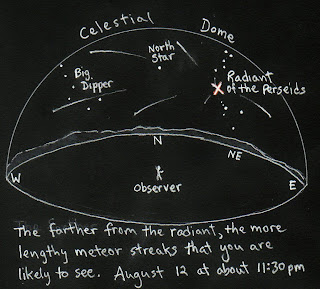
Peaking on Sunday night/Monday morning is the Perseid Meteor Shower. Every year about this time, our Earth sweeps through an old debris trail from Comet Swift - Tuttle. Grains of dust enters our planet's upper atmosphere at a staggering 40 miles per second. The tiny shock wave thusly generated heats the air around the grain, causing it to glow. This lasts for just a second or so.
To see this event, sit in a comfortable chair after 11:30 p.m. on Sunday night and face northeast, if you can. If you are lucky, the meteors zip by at a rate of 60 per hour. The source of the meteors on the celestial dome is just below the "w" of Cassiopeia.
Such is the view from Earth...
Thursday, August 9, 2007
Mars becomes a player

For the next 6 months, bright red Mars stands out among the background stars of Taurus and Gemini. During August, it slides between two star clusters, the Hyades and the Pleiades. Look in the east about 4:00 a.m. As the weeks pass, Mars rises earlier and earlier, and by month's end it pops above the horizon before 12:30 a.m.
Compare its brightness and color with the star Aldebaran. In the coming months, Mars grows considerably brighter, eventually outshining Aldebaran by nearly 10 times.
Such is our view from Earth...
Friday, July 27, 2007
Drifting Jupiter

Throughout August, Jupiter slowly and steadily drifts eastward with respect to the background stars. Binoculars will help follow this subtle motion. Around 10 pm on any evening over the next few weeks, note the bright planet's position as it moves away from a dim star that is next to it on July 30.
This is all due to the comibined effects of the relatively fast Earth moving towards to opposite side of the sun as Jupiter.
Such is our view from Earth...
Subscribe to:
Posts (Atom)