Monday, March 24, 2008

Mars is on the move


After several months of lurking near the Gemini-Taurus-Auriga borders, Mars makes its move to the east. On March 28, 29, and 30, the Red Planet glows next to the not-so-bright star Mebsuta in Gemini. Try using binoculars to separate the pair. By April 16, it sits next to another little known star, Wasat. Again, bring out the binoculars to split them.

An isosceles triangle is formed on April 27 when Mars begins to pass Pollux and Castor. All three of these objects have about the same brightness. Mars continues for another week when it then lines up with the twins, making for a triplet!

Such is our view from Earth...

Sunday, March 2, 2008

The Inner Planets, pt. 2


Mercury is often difficult to spot, but not now — if the skies are clear. In the first part of March, the solar system's smallest planet appears in our dawn sky close to the-easily-viewed Venus. Look to the southeast at about 6:10 to 6:15 a.m. for bright Venus poking above the horizon. Much dimmer Mercury lies to its upper right. Binoculars will help you discover this diminutive world.

Good hunting!

Such is our view from Earth...

Thursday, February 28, 2008

The Two Inner Planets

Mornings during the seven days or so offer the skywatcher a chance to glimpse our solar system's two inner planets, Mercury and Venus. Their angular separation from the sun isn't great so they rise shortly before sunrise. Try looking very low in the east at 6:20 a.m. for bright Venus with dimmer Mercury above it. On March 5, the thin crescent moon joins them, but all three may be lost in the brightening twilight.

Such is our view from Earth...

Wednesday, February 20, 2008

Eclipse and clouds

Unfortunately, the weather in southwest Virginia includes a generous amount of clouds during the total eclipse of the moon tonight. Therefore, the public observing near Explore Park session is cancelled. This certainly does not rule out people looking up on their own! Give it a try!

Even if it is cloudy, the backlit clouds resulting from the full moon, will be absent during totality. Between 10 and 11 pm, the clouds should be dark, except for any up-lighting from city lights below.

Such is our view from southwest Virginia...

Public viewing of the eclipse

If the skies are clear tonight, the total eclipse is for all to see!
Partial phase begins — 8:43 p.m.
Total phase begins — 10:01
Total phase ends — 10:52
Partial phase ends — 12:09 a.m.

The Roanoke Valley Astronomical Society will hold a special observing session in honor of the Total Eclipse of the Moon.
When — Wednesday, February 20, 2008
Time — 8:30 p.m. to 11:30 p.m.
Where — First overlook on the Explore Park spur off the Blue Ridge Parkway
Telescopes will be focusing on the moon, Saturn, and other objects of interest.
The public is welcome! The event is free.
Of course, this public observing event occurs only if the skies are clear!

Such is our view from Earth...

Tuesday, February 19, 2008

Enjoy the total eclipse of the moon!


On Wednesday evening the bright full moon moves into the Earth's shadow becoming completely eclipsed. The show begins at 8:43 p.m. EST as the moon slides into darkness. By 10:01 it moves entirely into our planet's shadow and the stars come out. To the moon's lower left is the ringed planet, Saturn while above it shines Regulus, the brightest star in the constellation Leo.

How dark will the moon appear? What color will it appear? Usually, it is not so dark that it can't be seen and its color is a dark coppery red. But none of this is definite!

Use binoculars to view a dim star near the moon's lower left edge. As the minutes pass, the moon moves closer to it, finally occulting it at 10:27. The star pops out the other side at about 11:17. By then totality is long over and the star may be difficult to spot in the increasing moonlight.

Totality ends at 10:52 p.m. A thin sliver of light spills from the dark disk's lower edge. Our sky grows brighter, quickly blotting out the dimmer stars. By 12:09 a.m. the partial phase ends as the moon moves completely out of the Earth's shadow. This is the same shadow that causes our "night." We happen to stand in the first few feet of our planet's shadow.

Such is our view from Earth...

Saturday, February 9, 2008

Moon passes the Pleiades and Mars


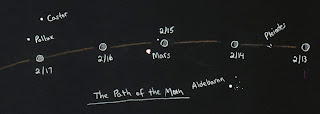
From 2/13 through 2/17, the moon passes several notable celestial objects. First, on the evening of February 13 the nearly first quarter moon sits to the west of the Pleiades star cluster. The following night, it jumps east of the Pleiades. On the 15th, the glaring orb is next to bright Mars. By February 17 the moon is in a fat gibbous shape shining to the lower right of the stars Pollux and Castor in the constellation Gemini. Why not follow it on its journey across the celestial dome?

Such is our view from Earth...