Friday, August 10, 2007

Here comes the mid summer favorite: The Perseid Meteor Shower


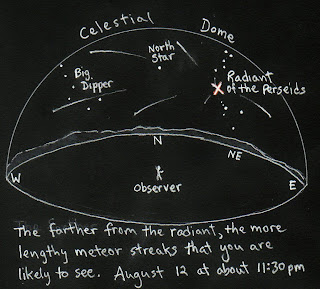
Peaking on Sunday night/Monday morning is the Perseid Meteor Shower. Every year about this time, our Earth sweeps through an old debris trail from Comet Swift - Tuttle. Grains of dust enters our planet's upper atmosphere at a staggering 40 miles per second. The tiny shock wave thusly generated heats the air around the grain, causing it to glow. This lasts for just a second or so.

To see this event, sit in a comfortable chair after 11:30 p.m. on Sunday night and face northeast, if you can. If you are lucky, the meteors zip by at a rate of 60 per hour. The source of the meteors on the celestial dome is just below the "w" of Cassiopeia.

Such is the view from Earth...

Thursday, August 9, 2007

Mars becomes a player


For the next 6 months, bright red Mars stands out among the background stars of Taurus and Gemini. During August, it slides between two star clusters, the Hyades and the Pleiades. Look in the east about 4:00 a.m. As the weeks pass, Mars rises earlier and earlier, and by month's end it pops above the horizon before 12:30 a.m.

Compare its brightness and color with the star Aldebaran. In the coming months, Mars grows considerably brighter, eventually outshining Aldebaran by nearly 10 times.

Such is our view from Earth...

Friday, July 27, 2007

Drifting Jupiter


Throughout August, Jupiter slowly and steadily drifts eastward with respect to the background stars. Binoculars will help follow this subtle motion. Around 10 pm on any evening over the next few weeks, note the bright planet's position as it moves away from a dim star that is next to it on July 30.

This is all due to the comibined effects of the relatively fast Earth moving towards to opposite side of the sun as Jupiter.

Such is our view from Earth...

Sunday, July 15, 2007

Crescent moon joins Saturn and Venus on July 16


The thin crescent moon hangs next to the much dimmer Saturn at about 9:15 pm on July 16. Brilliant Venus shines just to their left. This is your last chance to see the Ringed Planet before it becomes lost in the solar glare!

Monday, June 25, 2007

Venus passes Saturn in late June and early July


An interesting scene occurs in the west just after sunset during the next week. Brilliant Venus appears to move underneath the much dimmer Saturn. They may appear next to each other, but Saturn is 23 times farther away! Look for this about 10 pm.

Such is our view from Earth...

Friday, June 22, 2007

Space Station and Atlantis in our western sky


At 10:54 p.m. on Wednesday June 20, the International Space Station and Space Shuttle Atlantis (STS—117) passed across our western sky. They separated earlier in the day for the shuttle's eventual return to Earth. In this image, the ISS is the upper left streak and Atlantis is the other streak. The six day old moon is at the far left while Venus is setting at the bottom. Saturn is to Venus' upper left and Regulus is to Saturn's upper left.

The pair continued to the upper left for another 45 seconds until they disappeared in the Earth's shadow above the moon. The exposure was for 15 seconds, which provides an idea of how fast they were traveling across the sky.

Such is our view from Earth...

Wednesday, June 20, 2007

Passing of the Space Station and Space Shuttle


The International Space Station along with the Space Shuttle will pass in our western skies just before 11 pm tonight (6/20). Look low in the west at 10:54 p.m. A moderately bright "star" will be found moving to the upper right of brilliant Venus. It continues to the upper left passing to Saturn's upper right. At about 10:55:30 it moves to the upper right of the crescent moon. By 10:56 it is lost from view as it enters the Earth's shadow.

Take advantage of the great weather and wave at these technological marvels.

Such is our view from southwest Virginia...